

The Automation Illusion
Many independent business owners believe they are ahead of the curve because they use generative AI to draft emails or write marketing copy. That was the benchmark for 2023. In 2026, the paradigm has entirely shifted.
The conversation is no longer about AI as a simple assistant; it is about AI as an autonomous operator. We have entered the era of “Agentic AI,” where digital agents do not just generate text, they take action. However, there is a massive roadblock for most small to mid-sized businesses: you cannot run an advanced AI engine on a broken, ad-hoc operational track. If your business relies on manual data entry and “Frankenstack” software (disjointed tools that don’t communicate), you are about to be severely outpaced by competitors who have centralized their infrastructure.
The Insight: The Rise (and Risk) of Agentic AI
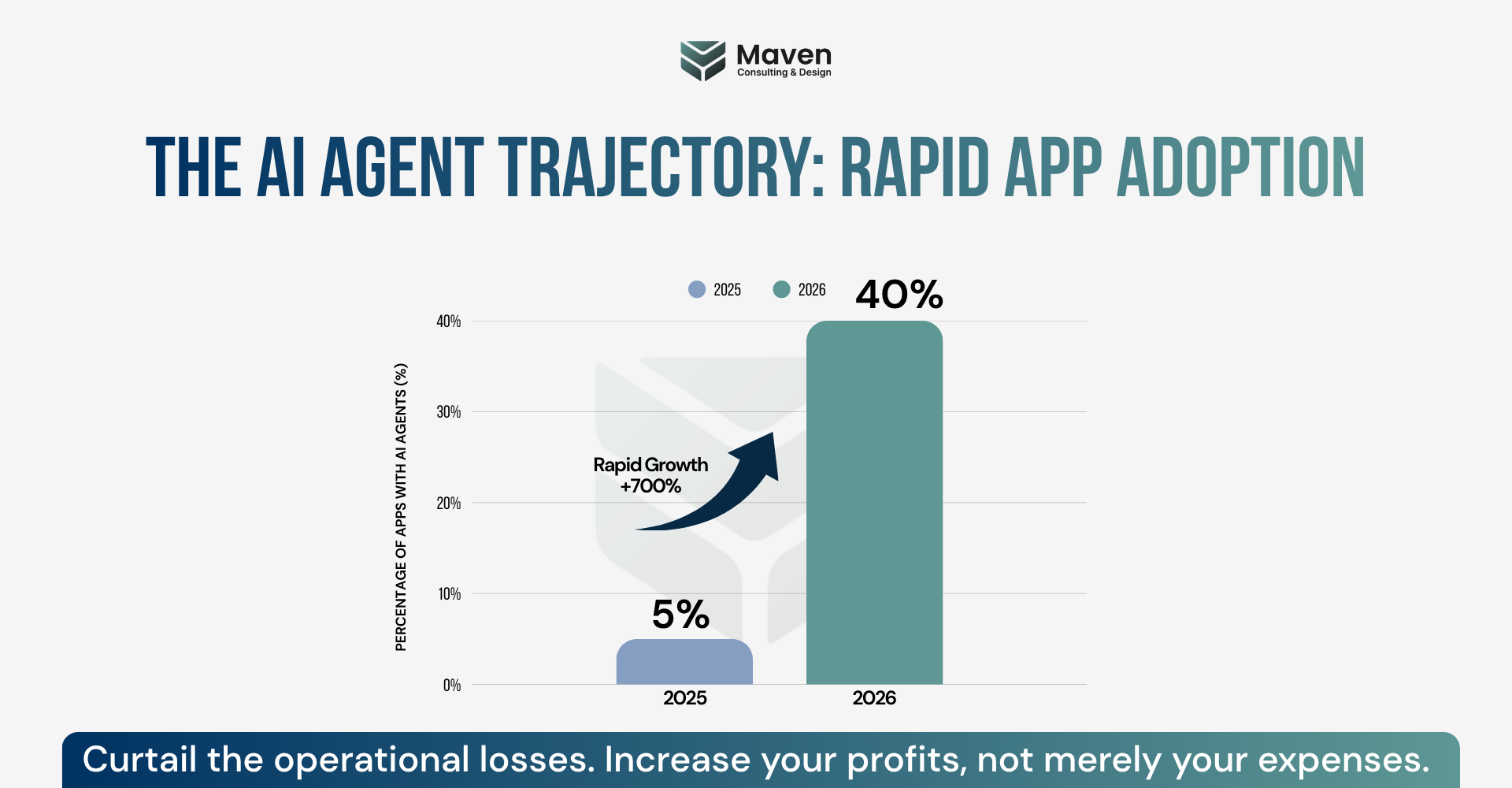
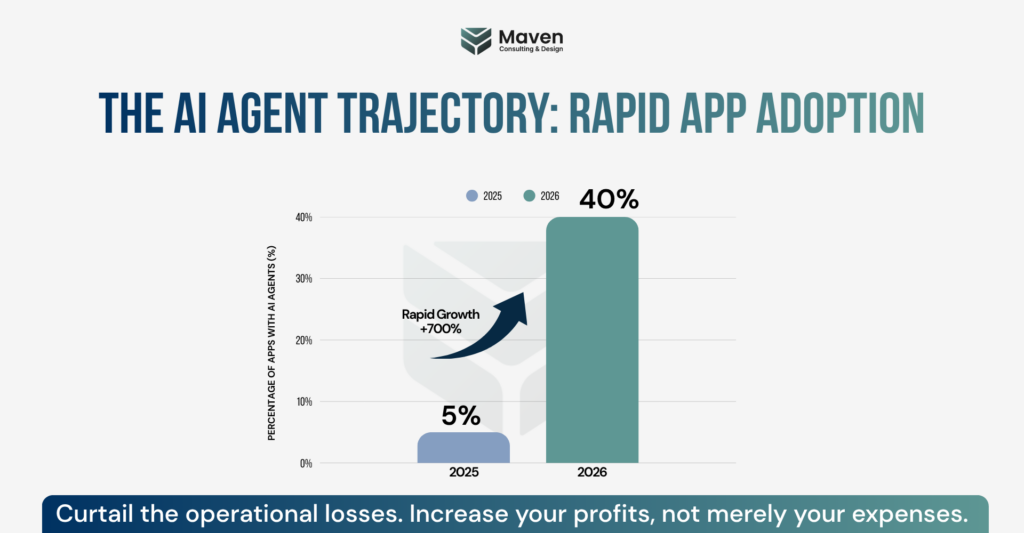
To understand the urgency, you have to look at the enterprise data. Gartner predicts that 40% of enterprise applications1 will embed task-specific AI agents by the end of 2026, a massive jump from less than 5% a year earlier. These agents are designed to triage customer requests, update CRM records, and route tasks across systems autonomously.
But here is the critical insight: AI failure is rarely a technology problem; it is an infrastructure problem. Gartner expects more than 40% of agentic AI projects1 to be canceled by the end of 2027. Why? Because businesses lack clear governance, risk controls, and proper data access. The organizations winning the automation race treat data and tool access as the real bottleneck, securely connecting their AI agents directly to the systems where the work actually happens. If your operations rely on an employee remembering to copy-paste a client’s email from Wix to a loose Excel sheet, an AI agent cannot help you.
The Solution: Build the Operational Scaffolding First
The statistics are clear: the SMB adoption rate for AI jumped to 38% in 20262. Furthermore, 72% of businesses3 have now adopted AI in at least one function. But to achieve the reported 250% average ROI2 on AI automation within 18 months, you have to clean house first.
You must transition from a fragmented toolset to an API-first, consolidated operational framework.
- Kill the Silos: Audit your tech stack and move all client data, project management, and billing into a unified RevOps (Revenue Operations) platform.
- Establish Governance: Document your standard operating procedures (SOPs). AI agents need strict rules, permission gates, and audit trails to function safely.
- Leverage Fractional Leadership: You do not need a full-time, expensive executive to build this. Partnering with a fractional C-Suite team allows you to rapidly build the structural efficiency required to deploy automated workflows safely and profitably.
You cannot scale chaos, and you certainly cannot automate it. Before you invest in the next era of AI, you need an operational foundation that can support it. Contact Maven Consulting & Design today for a Fractional C-Suite strategy session, and let us prepare your digital infrastructure for true, autonomous scale.
Works Cited
- https://www.gartner.com/en/newsroom/press-releases/2025-08-26-gartner-predicts-40-percent-of-enterprise-apps-will-feature-task-specific-ai-agents-by-2026-up-from-less-than-5-percent-in-2025
- https://m.economictimes.com/ai/ai-insights/how-agentic-ai-is-growing-and-how-enterprises-can-make-the-best-of-it/articleshow/132109550.cms
- https://agiled.app/statistics/ai-business-statistics