
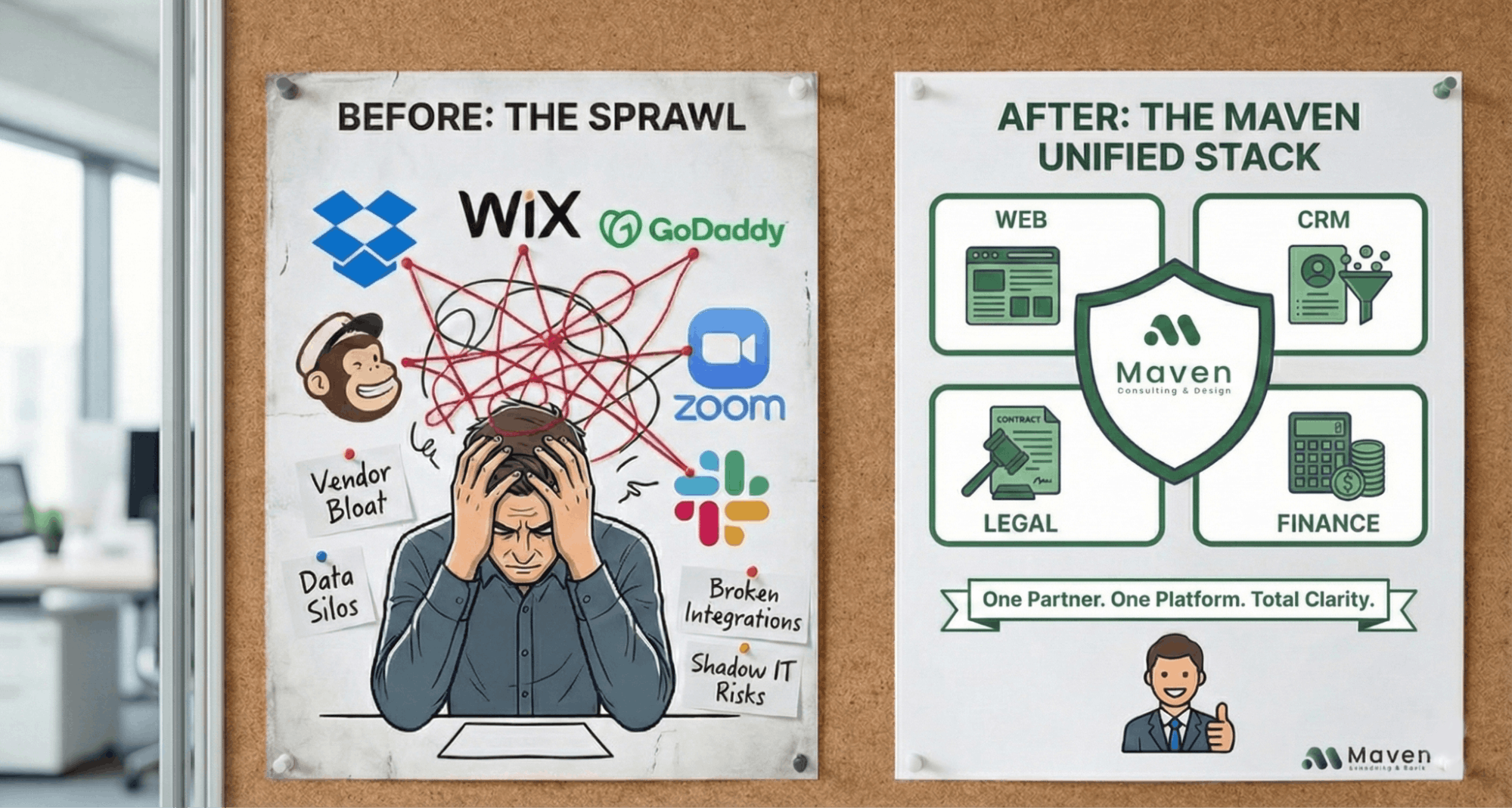
Your Credit Card Statement is a Red Flag
If we looked at your company’s monthly statement, we’d likely find a graveyard of $20 to $200 subscriptions. A Wix site here, a Calendly link there, a Mailchimp account nobody has logged into since last July, and an “SEO guy” on a recurring retainer.
In the trades and real estate sectors, this is known as “Tool Sprawl.” What started as a way to “stay digital” has become a liability. You aren’t just paying for software (hard costs), you are paying a “complexity tax” (soft costs) every time an integration breaks or a staff member needs to learn a fifth user interface.
This fragmentation creates “Operational Fragility.” When critical business info like passwords or contacts lives in one person’s head or on a single app, you have a massive point of failure.
The Insight: 2026 is the Year of the Consolidation Imperative
The era of “there’s an app for that” is being replaced by “there’s a platform for everything”. According to the Vendor Consolidation 2026 Framework1, 75% of organizations are now pursuing consolidation strategies to regain control.
Why the sudden shift?
- Rising Costs: Global IT costs are expected to rise by nearly 10% in 2026. Organizations can no longer afford reactive spending.
- Shadow IT Risks: Without a unified system, employees use unauthorized tools to get work done, opening massive security gaps.
- The Margin Squeeze: Midsize companies have recently cut SaaS tools by 18% just to regain budget control.
As highlighted in the CIO Trends 2025: The Consolidation Imperative2, platformization is now the mandate for any business wanting to stay competitive. It turns a fragmented supply base into a focused, value-generating ecosystem.
The Solution: The Maven “Unified Stack”
At Maven, we don’t believe in vendor sprawl. We believe in Operational Hygiene. We act as your “Holistic Business Architect,” replacing your disjointed subscriptions with a single, structural scaffolding.
By bundling Web Design, CRM, and Corporate Structuring (Incorporation, Contracts, WSIB), we eliminate the administrative drag that keeps you “in” the business instead of “on” it. This aligns with 10 Practical IT Cost Optimization Strategies for SMBs3, which ranks vendor consolidation as a top priority for 2025-2026.
The Maven Protocol vs. The “Barnacle” Model
| Feature | Traditional “Sprawl” | The Maven Unified Stack |
| Tech Stack | Wix + Mailchimp + Calendly + Dropbox | Integrated CRM + Web + Hosting |
| Strategy | DIY or “The SEO Guy” | Fractional C-Suite (CMO/CTO) |
| Risk | High (Data Silos/Shadow IT) | Protective (WSIB, Legal, Security) |
| Cost | Inflated (Vendor Bloat) | Predictable Monthly Retainer |
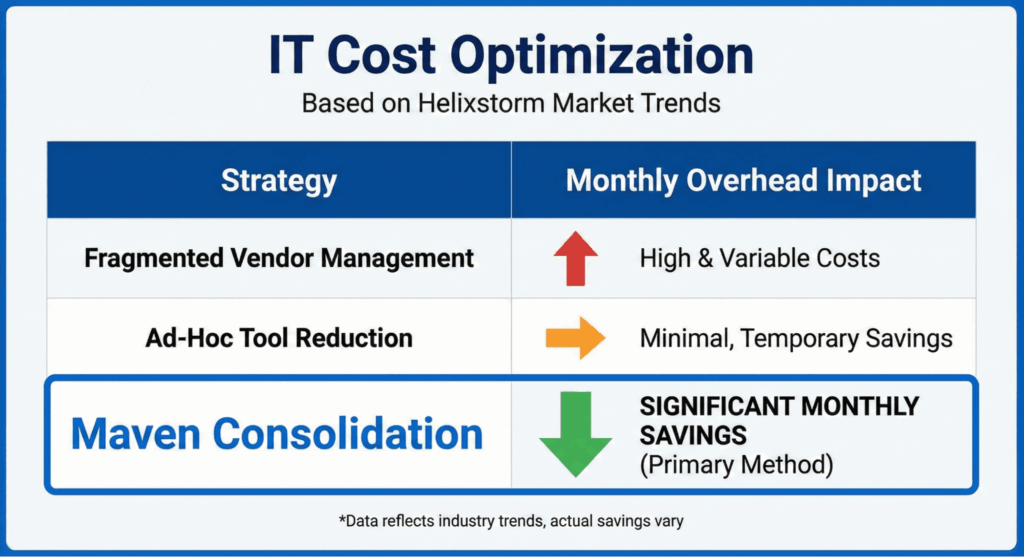
Ready to clean up the digital mess? Stop acting like a “guy with a truck” and start operating like a professional enterprise. Let Maven audit your current tech stack. We will identify the “SaaS barnacles” slowing you down and replace them with a unified system built for scale.
Works cited:
- Vendor Consolidation 2026: A Framework for Smarter Procurement, Gatekeeper, https://www.gatekeeperhq.com/blog/vendor-consolidation.
- CIO Trends 2025: The Consolidation Imperative Takes Center Stage, https://news.sap.com/2025/08/cio-trends-2025-the-consolidation-imperative-takes-center-stage/
- 10 Practical IT Cost Optimization Strategies for SMBs in 2025, https://eaglepointtech.com/it-cost-optimization-strategies/
- Top IT Services Trends in 2026 – Helixstorm, https://www.helixstorm.com/managed-it-services/top-it-services-trends-2026/